
How should we fight sin in our lives? Download a PDF of Grace Driven Effort here. This was originally published in two posts located here and here.
Tag Archives: Grace
The Explicit Gospel
A truth that will change you
“Long ago, at many times and in many ways, God spoke to our fathers by the prophets, but in these last days he has spoken to us by his Son, whom he appointed the heir of all things, through whom also he created the world. He is the radiance of the glory of God and the exact imprint of his nature, and he upholds the universe by the word of his power. After making purification for sins, he sat down at the right hand of the Majesty on high, having become as much superior to angels as the name he has inherited is more excellent than theirs.” (Hebrews 1:1–4 ESV); “But of the Son he says, “Your throne, O God, is forever and ever, the scepter of uprightness is the scepter of your kingdom. You have loved righteousness and hated wickedness; therefore God, your God, has anointed you with the oil of gladness beyond your companions.”
And, “You, Lord, laid the foundation of the earth in the beginning, and the heavens are the work of your hands; they will perish, but you remain; they will all wear out like a garment, like a robe you will roll them up, like a garment they will be changed. But you are the same, and your years will have no end.”” (Hebrews 1:8–12 ESV)
God’s revelation to man is complete because He has now spoken to us by through His own Son, who is the exact imprint of His nature. It is through Jesus that the world was created and is held together – He is no angel, He is God Himself. God deals with our problem of rebellion and sin by offering the only sacrifice that is just and acceptable: the death of a perfectly, obediently (flawless) lived life that is given to those who abandon their self-reliant efforts and completely trust in Him. No other sacrifice is necessary, the alter has been closed. Jesus is now seated in the place of absolute, sovereign authority where He rules and reigns. He is the eternal, perfectly righteous king that governs justly so that His kingdom is one of peace – the restful rhythm of Eden will return. With the same ease that Jesus created the world, He will roll it up like a pair of socks – these are created things that change and end – He is eternal and never changes. Hallelujah! God rules and reigns in absolute authority; He is unchanging, all powerful, eternal – and He has set His affections upon us! Despite how things look or how you are currently feeling, dwell on this truth and allow it to change you; allow it to provide an anchor for your soul.
Abandoning accomplishment
“Indeed, I count everything as loss because of the surpassing worth of knowing Christ Jesus my Lord. For his sake I have suffered the loss of all things and count them as rubbish, in order that I may gain Christ and be found in him, not having a righteousness of my own that comes from the law, but that which comes through faith in Christ, the righteousness from God that depends on faith” (Philippians 3:8–9 ESV)
Paul jettisoned all of his hard fought obedience and accomplishments and viewed them as worthless. He found that he was righteous before God not because of what he had accomplished or how well he obeyed, but by faith in Jesus’ perfectly lived life on his behalf. God “imputes” (gives) Christ’s perfectly obedient life to the person who depends upon God for salvation. When God views the believer, He sees the sinless perfection (righteousness) that Jesus earned for us.
Shrinking the Cross
“Notice that the top line of the chart is labeled “Growing Awareness of God’s Holiness. ”As we stated last time, this does not mean that God’s holiness itself is increasing, for God is unchangeable in his character. He has always been infinitely holy. Rather, this line shows that when the gospel is functioning correctly in our lives, our awareness of God’s holy character is constantly growing. We realize in fuller and deeper ways the weight of God’s glorious perfections.
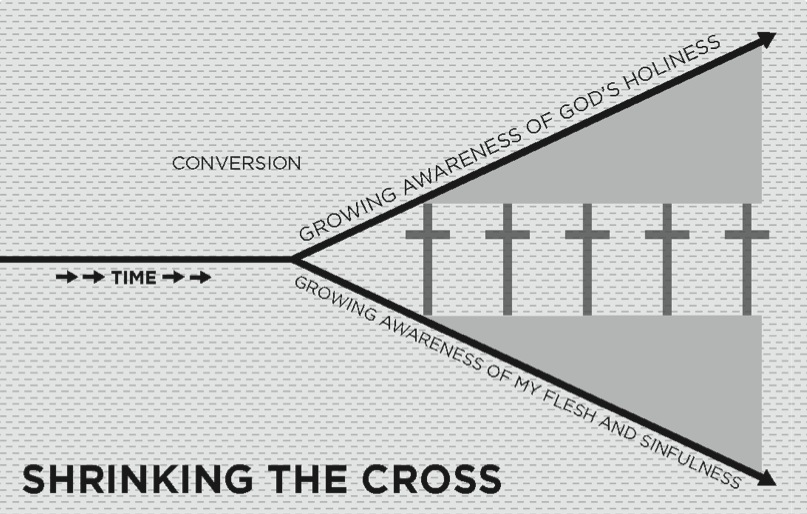
Likewise, the bottom line shows that when the gospel is functioning correctly in our lives, our awareness of our own sinfulness is consistently growing. This does not mean that we are becoming more sinful. (In fact, if we’re growing in Christ, we’ll be starting to see victory over sin.) But we are realizing more and more “how deep the rabbit hole goes” in our character and behavior. We are seeing that we are more profoundly sinful than we first imagined.
“As these two lines diverge, the cross becomes larger in our experience, producing a deeper love for Jesus and a fuller understanding of his goodness. At least that’s the ideal. But, in reality, because of indwelling sin, we are prone to forget the gospel—to drift away from it like a boat loosed from its moorings. That’s why the Bible urges us not to be “moved [away] from the hope held out in the gospel” (Col. 1:23) and to “let the word of Christ dwell in [us] richly” (Col. 3:16). When we are not anchored in the truth of the gospel, our love for Jesus and our experience of his goodness become very small. We end up “shrinking the cross” by either pretending or performing.
Look again at the bottom line of the chart. Growing in our awareness of our sinfulness is not fun! It means admitting—to ourselves and others—that we are not as good as we think we are. It means confronting what Richard Lovelace called the complex web of “compulsive attitudes, beliefs, and behavior”* that sin has created in us. If we are not resting in Jesus’ righteousness, this growing awareness of our sin becomes a crushing weight. We buckle under its load and compensate by pretending that we’re better than we really are. Pretending can take many forms: dishonesty (“I’m not that bad”), comparison (“I’m not as bad as those people”), excuse making (“I’m not really that way”), and false righteousness (“Here are all the good things I’ve done”). Because we don’t want to admit how sinful we really are, we spin the truth in our favor.
Growing in our awareness of God’s holiness is also challenging. It means coming face to face with God’s righteous commands and the glorious perfections of his character. It means realizing how dramatically we fall short of his standards. It means reflecting on his holy displeasure toward sin. If we are not rooted in God’s acceptance of us through Jesus, we compensate by trying to earn God’s approval through our performance. We live life on a treadmill, trying to gain God’s favor by living up to his expectations (or our mistaken view of them).”
The Gospel Centered Life by Bob Thune & Will Walker (Page 24-25)
Free at Last!
Tullian Tchividjian recently started a new series on the book of Galatians entitled Free At Last, here are some of the highlights from the first installment.
- “The Roman Catholic Church of his day had so distorted the gospel of God’s free grace by adding our need to do to Christ’s ‘it is finished.'”
- “The performance driven, do it yourself, check list version of Christianity the pervades the church today sadly mirrors the church at the time of the reformation.”
- There is a constant temptation that we all have to add something to the finished work of Christ.
- “Grace is not an abstract concept; grace is Jesus Christ who gave himself for our sins.” Galatians 1:4
- “Law promises that life can be formulaic, it gives us a sense of manageability. The Law seems safe because it is predictable.”
- “Grace throws our glory train off the tracks, it wrestles control out of our hands.”
- “It’s easy to run back to the law, it’s more natural to run back to the law…It’s very easy to go back to the formulas, it’s very easy to go back to the check lists and to do lists, it’s easy, there’s something inside of us that craves it – that wants it. And what we don’t realize is that thing inside, that part of us inside that craves it is that part of us that is resisting grace.”
- “We think it’s just fine to say, ‘ok, I get it, but tell me what to do.’ That’s the part of you that needs to be put to death.”
- “Perhaps, maybe we can regain control of our marriage, or regain control of our children or regain control of this that or the other, if you’d just tell us what to do. Give us a checklist so I can get back in control of my life.”
- This is not new, it’s OLD and has been LOST FOR SO LONG!
- “The flesh is always resistant to “it is finished’ – always.”
- “Mortification begins with that part of us that resists grace.”
- “God demands perfection, not progress.”
Download here
It’s all grace or it’s not grace at all
The degree to which we believe that grace alone saves us is the degree to which we will walk freely in our faith. A “yes grace, but,” mentality is what keeps morality and self righteousness swimming around inside of us, our families and churches. It is not as if we took some spiritual medicine that God, the good doctor, offered to us or that we flipped on the light switch while God provided the light and power. NO! The bible says that we were dead and that God, being rich in mercy made us alive (Ephesians 2:1-11, Colossians 2:13-14). We played no part, we did not flip the switch, we did not take the medicine. Dead men don’t do things! Jerry Bridges says it like this:
“To the extent that you’re clinging to any vestiges of self-righteousness or putting any confidence in your own spiritual attainments, to that degree you are not living by the grace of God in your life. This principle applies both in salvation and in living the Christian life. Grace and good works (that is, works done to earn favor with God) are mutually exclusive. We cannot stand, as it were, with one foot on grace and the other on our own works of merit. If you’re trusting to any degree in your own morality or religious attainments, or if you believe God will somehow recognize any of your good works as merit toward your salvation, you need to seriously consider if you’re truly a Christian. We must be absolutely clear about the truth of the gospel of salvation. More than two hundred years ago, Abraham Booth (1734-1806), a Baptist pastor in England, wrote, “Let the reader … carefully remember, that grace is either absolutely free, or it is not at all: and, that he who professes to look for salvation by grace, either believes in his heart to be saved entirely by it, or he acts inconsistently in affairs of the greatest importance.”” Gerald Bridges;Jerry Bridges. Holiness Day by Day: Transformational Thoughts for Your Spiritual Journey Devotional (p. 48). Kindle Edition.
A good and all powerful God has made a way for rebellious creatures
A good and all powerful God has made a way for rebellious creatures to return and be reconciled with Him; this is freely offered to everyone that will completely abandon all trust in their own morality and effort and will place their full trust in the perfectly lived life and sacrificial death of Jesus.
Why Christians never graduate from their need for the gospel
What is the Gospel? “When you were dead in your sins and in the uncircumcision of your sinful nature, God made you alive with Christ. He forgave us all our sins, having canceled the written code, with its regulations, that was against us and that stood opposed to us; he took it away, nailing it to the cross.” (Colossians 2:13–14 NIV)
Paul is “eager to preach the gospel to” (Romans 1:15 ESV) “all those in Rome who are loved by God and called to be saints” (Romans 1:7 ESV); why would Paul be eager to preach the gospel to Christians? Isn’t the gospel primarily for the unregenerate that need to repent and be saved? No, Paul views the gospel – the proclamation of good news that God has made a way for sinners to be reconciled with Him – not only as the means by which unbelievers are saved, but also as the central component for ongoing growth and transformation in our faith (“And you, who once were alienated and hostile in mind, doing evil deeds, he has now reconciled in his body of flesh by his death, in order to present you holy and blameless and above reproach before him, if indeed you continue in the faith, stable and steadfast, not shifting from the hope of the gospel that you heard, which has been proclaimed in all creation under heaven, and of which I, Paul, became a minister.” (Colossians 1:21–23 ESV)
The Scriptures call us to walk by faith (trust) and not by sight (2 Corinthians 5:7) – for our faith is grounded in a hope in what we cannot see (Hebrews 11:1). We now walk not according to what we can see and can accomplish by our own efforts, but by the power of the Holy Spirit (Romans 8:4); Galatians 5:6 says it like this: “for in Christ Jesus neither circumcision nor uncircumcision counts for anything, but only faith working through love.” (Galatians 5:6 ESV). Paul persists in his letter to the Corinthians that the gospel is of singular importance in their lives of faith – “for what I received I passed on to you as of first importance: that Christ died for our sins according to the Scriptures, that he was buried, that he was raised on the third day according to the Scriptures” (1 Corinthians 15:3–4 NIV). Behavioral change is not accomplished by our hard fought discipline or white knuckled effort; at the root of us presenting our bodies as living sacrifices that are holy and acceptable to God is connecting this effort to the mercies of God that are most visible in God’s saving work in our lives (Romans 12:1). It is this kindness that prompts us to live continually repentant lives (Romans 2:4).
An ever growing awareness of God’s holy nature, our failure to measure up and the glorious grace of the gospel that bridges this gap should be where the Christian  spends His time and energy investing. Our disciplines should be aimed at beholdingthe glory of God and reveling in His grace – for as we behold Him we become more like Him: “And we all, with unveiled face, beholding the glory of the Lord, are being transformed into the same image from one degree of glory to another.” 1 Corinthians 3:18
Talking to yourself, developing desire for God and our need for Grace
How do we develop a desire for God? How do we fight spiritual apathy and foster affection for God? Why do we need grace, are we really awed by it? Here are some great articles and resources to help answer those questions:
- Are Christians Totally Depraved? by Tullian Tchividjian (why we need grace)
- Developing Desire – Learning to Talk to Yourself by Desiring God (developing desire)
- Don’t Give Up by Desiring God (hope and perseverance)
- Sacrifice It by Matt Chandler
- The Explicit Gospel by Matt Chandler
 The Gospel Centered Life